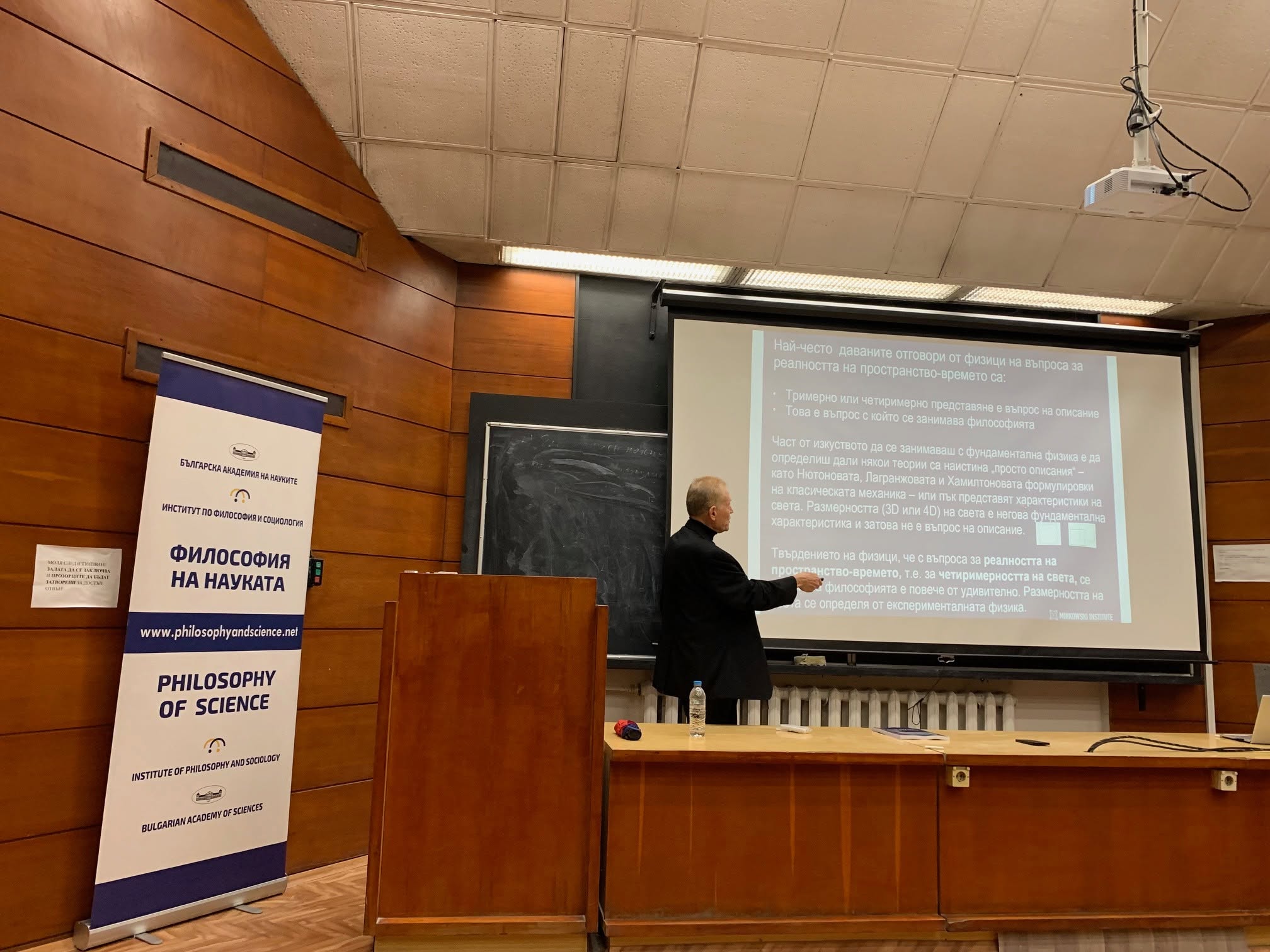
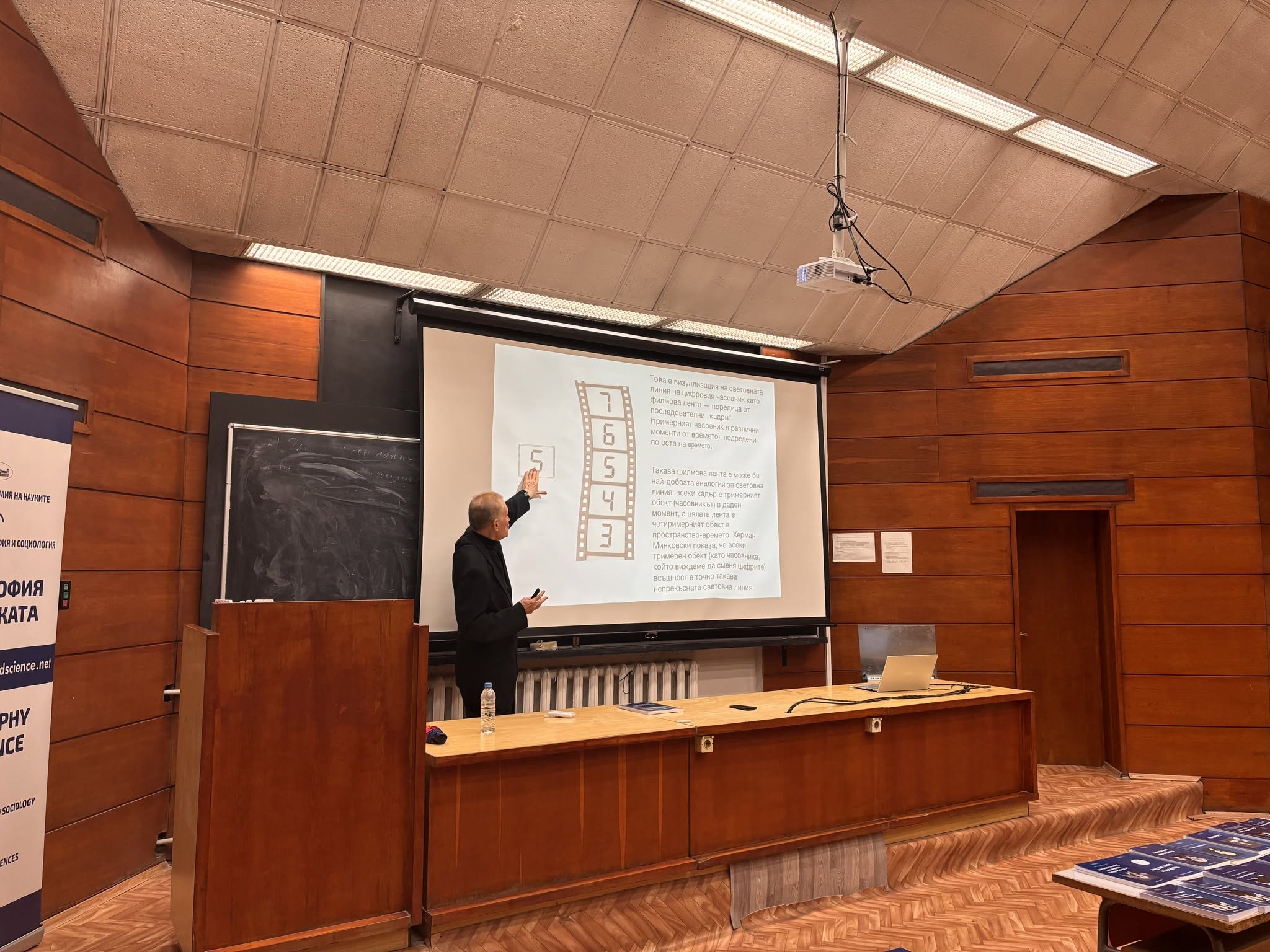
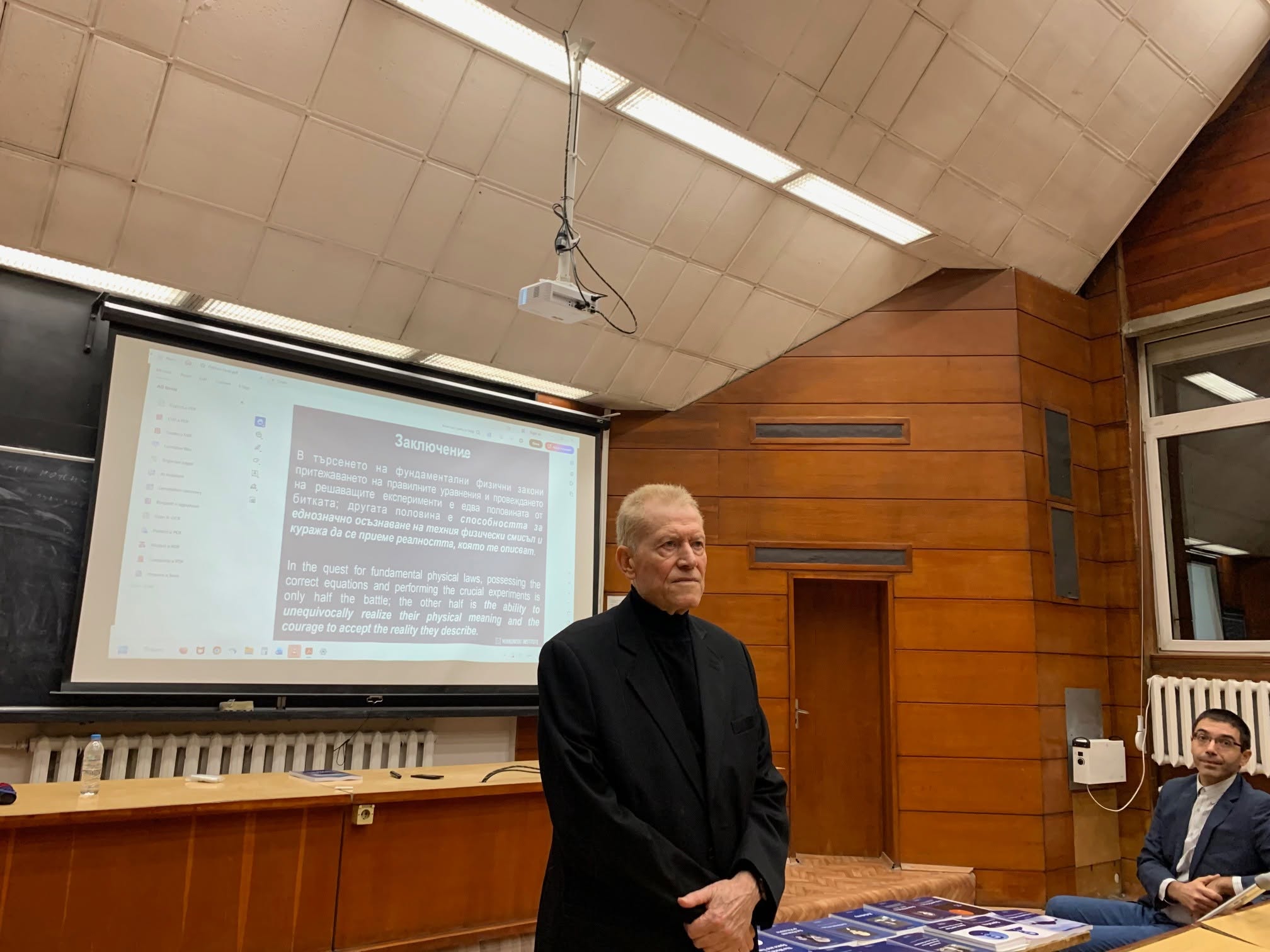
Slides of the talk "Spacetime: just a mathematical space or a real four-dimensional world? Why the answer is of decisive importance for fundamental physics."
English Version of the Poster
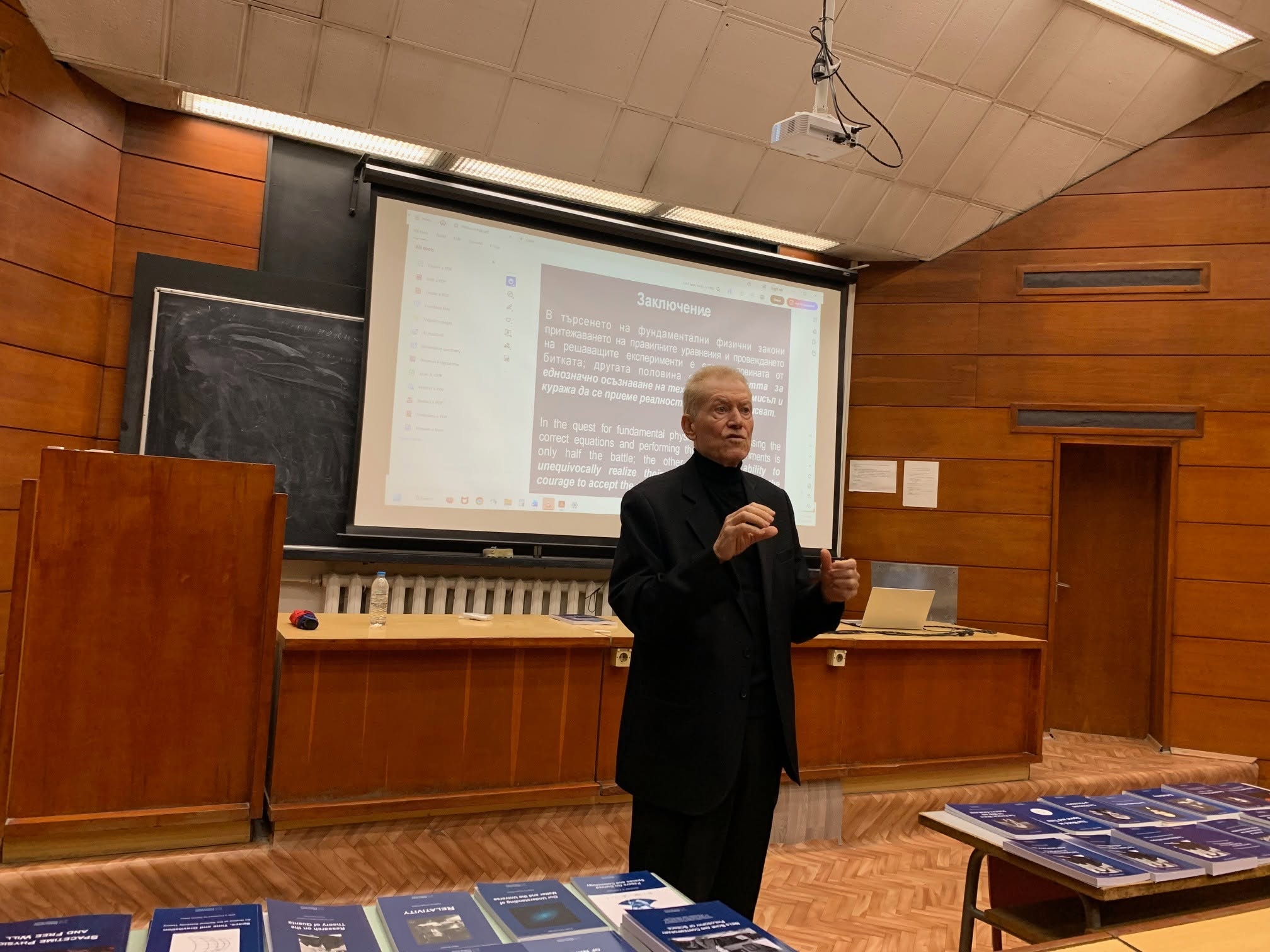
On November 10, 2026, at 6:00 p.m. in Room A209 of the Faculty of Physics of Sofia University "St. Kliment Ohridski" Prof. Vesselin Petkov (Minkowski Institute, Montreal, Canada) will give a public lecture at the invitation of the Faculty of Physics, Sofia University, and the Section "Philosophy of Science" of the Institute of Philosophy and Sociology at the Bulgarian Academy of Sciences, on the topic:
Spacetime: just a mathematical space or a real four-dimensional world? Why the answer is of decisive importance for fundamental physics
Prof. Vesselin Petkov is Director of the Minkowski Institute, Montreal, Canada. He graduated in nuclear physics from the Faculty of Physics of Sofia University. In 1988 he received his PhD in philosophy from the Institute of Philosophical Sciences at the Bulgarian Academy of Sciences, and in 1997 his PhD in theoretical physics from Concordia University, Montreal, Canada. He taught at Sofia University and Concordia University, Canada. In 2011, together with 11 renowned scientists, he founded the Institute for Foundational Studies "Hermann Minkowski" (known today as the Minkowski Institute). He has numerous publications in the fields of physics and philosophy. He is the author of Relativity and the Nature of Spacetime, 2nd ed. Springer: 2009, Inertia and Gravitation: From Aristotle's Natural Motion to Geodesic Worldlines in Curved Spacetime, Minkowski Institute Press: 2012, Seven Fundamental Concepts in Spacetime Physics, 2nd ed. Springer: 2024, among others.
You can learn more about the lecture from the attached poster here.
Immediately after the lecture, at 7:00 p.m., a presentation of two of the most recent volumes published by the Minkowski Institute Press will take place:
Anguel Stefanov and Vera Lyubenova (eds.), Niels Bohr and Contemporary Philosophy of Science. Minkowski Institute Press: 2026
Fernando di Mieri and Murli Manohar Verma (eds.), Spacetime Physics and Free Will. Minkowski Institute Press: 2026
The volume Niels Bohr and Contemporary Philosophy of Science is the 100th anniversary publication of the Press and presents the results of the international conference held in 2025 to mark the 140th anniversary of the birth of Niels Bohr. The conference was organized by the Section “Philosophy of Science” of the Institute of Philosophy and Sociology, BAS, with the support and partnership of the Faculty of Physics of Sofia University.
On November 10, the event will also be accompanied by a small exhibition of some of the books published by the Minkowski Institute Press, which currently number 102 titles. Guests will be able not only to browse the books but also to purchase those they wish at preferential prices.
You are welcome to attend the lecture and the presentation of the books!
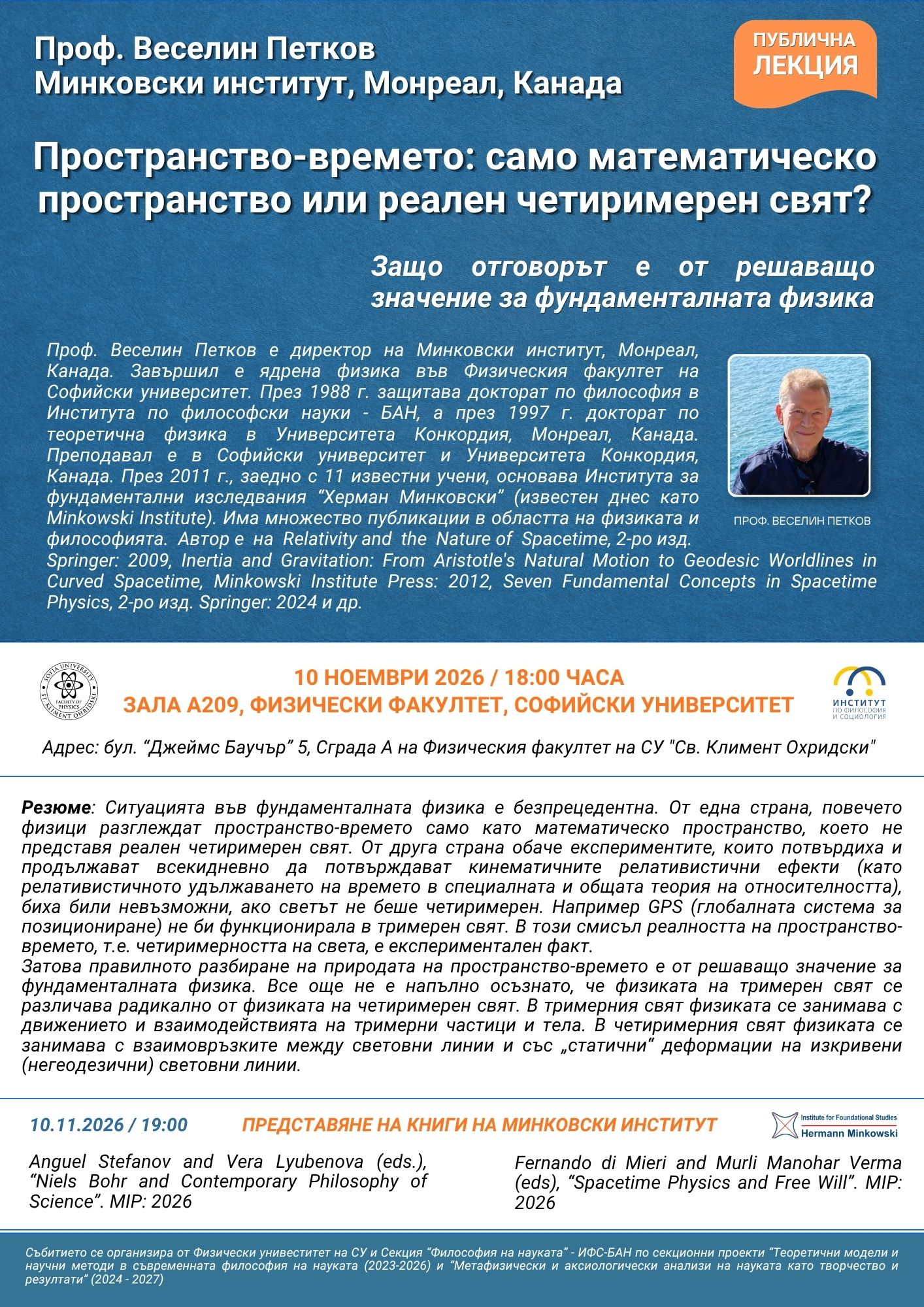
Poster at the site of the Faculty of Physics of Sofia University
Spacetime: just a mathematical space or a real four-dimensional world?
Why the answer is of decisive importance for fundamental physics
Vesselin Petkov
Minkowski Institute
Montreal, Canada
https://www.minkowskiinstitute.com
https://vesselinpetkov.com
vpetkov@minkowskiinstitute.com
Abstract
The situation in fundamental physics is unprecedented. On the one hand, most physicists regard spacetime merely as a mathematical space that does not represent a real four-dimensional world. On the other hand, however, the experiments that have confirmed, and continue to confirm daily, kinematic relativistic effects (such as special-relativistic time dilation and general-relativistic time contraction) would be impossible if the world were not four-dimensional. For example, GPS (the Global Positioning System) would not function in a three-dimensional world. In this sense, the reality of spacetime, i.e., the four-dimensionality of the world, is an experimental fact.
Therefore, a correct understanding of the nature of spacetime is of decisive importance for fundamental physics. It is still not fully appreciated that the physics of a three-dimensional world differs radically from the physics of a four-dimensional world. In a three-dimensional world, physics deals with the motion and interactions of three-dimensional particles and bodies. In a four-dimensional world, physics deals with the interrelations between worldlines and with "static" deformations of curved (non-geodesic) worldlines.
| Main Page |